Before you translate a word, look at what’s happening.
A raised eyebrow. A locked door. An empty glass. Someone running away. Visual information gives language context — another set of clues that can help you work out what you’re reading.
But do pictures actually help us learn a language? Research suggests they can — particularly when visual information is combined with words rather than used as a replacement for them.
A 2025 meta-analysis examined multimedia second-language vocabulary learning across studies involving 2,056 participants. It compared learning with first-language information, pictures, and combinations of the two.
For immediate vocabulary learning, combining first-language words with pictures performed better than using either first-language information or pictures alone. The advantage was less clear in delayed testing, so the research shouldn’t be interpreted as saying that adding a picture automatically guarantees better long-term learning.
The research is more interesting than simply saying “pictures are better.” The same 2025 meta-analysis found no significant difference overall between learning with first-language information alone and learning with pictures alone. The strongest immediate results came from combining the two.
That matters. A useful visual shouldn’t simply decorate a word. It can become another source of information that works alongside the language.
Imagine reading:
No abras la puerta.
On its own, you have only the words.
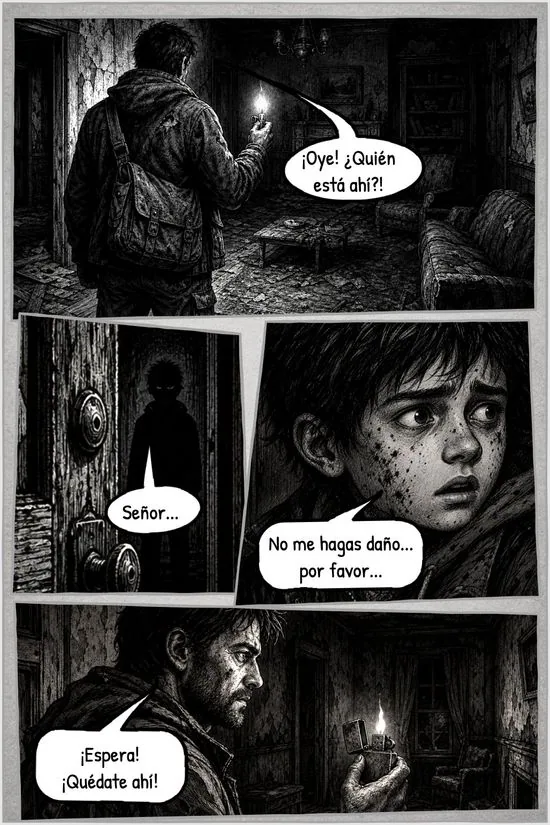
Now imagine those words inside a comic panel: one character looks frightened, another is reaching towards a door, and something appears to be waiting outside. Before reaching for a translation, the scene has already started narrowing down what the sentence might mean.
Don’t open the door.
That’s different from simply putting a picture next to a vocabulary word. A story supplies characters, actions, expressions, objects and consequences. The learner is using language inside a situation.
Visual context won’t always be enough. Sometimes you need to know exactly what a word means. That’s where interactive reading can add another layer.
A 2024 meta-analysis brought together 21 studies of second- and foreign-language vocabulary learning through digital reading. Overall, digital reading was associated with significant vocabulary-learning effects, although results varied according to factors such as learner proficiency, testing method and the digital resources available.
One particularly relevant finding was the usefulness of lexical glosses — explanations of unfamiliar words available while reading.
This is the thinking behind Comigo.
The comic gives the Spanish a visual situation. The speech bubbles give you the written language. Audio lets you hear the dialogue. Translations and vocabulary help are there when context isn’t enough. And the story gives you a reason to keep reading.
Comigo hasn’t been the subject of these academic studies, so we don’t claim that the research proves Comigo itself is more effective than other ways of learning Spanish. Instead, we’ve designed Comigo around several ideas that language-learning research has investigated: contextual reading, multimedia information, listening and accessible vocabulary support.
A moment from La Llegada (El Visitante, episode one). Look at the scene, then tap a speech bubble — hear the line spoken, and reveal the translation only when you want it. Just as in the app.
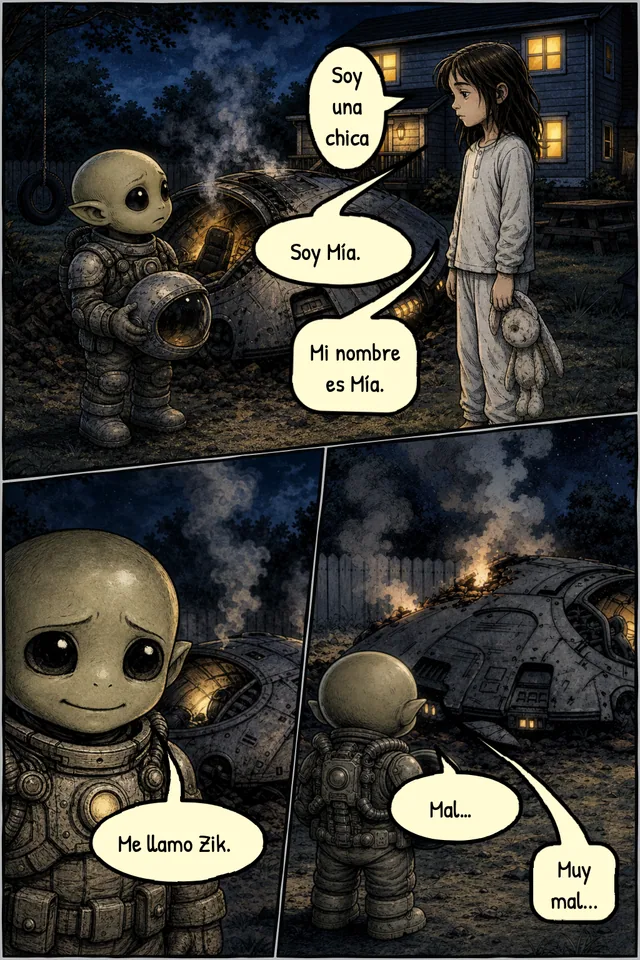
Read “Conociendo a Zik” as a full exercise, with the transcript, vocabulary and translation →
Read an original Spanish comic, use the pictures to follow the story, listen to the characters and ask for help only when you need it.